
Service · Borehole drillingBorehole drilling in Durban & KZN.
We drill boreholes for homes, farms, schools and commercial developments across Greater Durban and KwaZulu-Natal, from the hydro-siting survey to casing, capping and the first water. One team, our own rigs, since 2010.
★ 4.6 from 25 Google reviews · Est. 2010 · Pinetown, Durban
01
Who it’s for
Homeowners tired of water cuts, pipe bursts and rising municipal bills. Smallholdings and farms that need water for gardens, livestock and irrigation. Schools, churches, businesses and developments that can’t afford to stop when the municipal supply does.
A borehole gives you your own supply from the ground under your property. Paired with a JoJo tank and booster pump it can run the house; paired with a solar pump it keeps pumping through power outages too.
02
How we drill a borehole
Every project follows the same four steps, whether it’s a garden borehole in Westville or a supply for a development in Ballito.
- 01
Survey the site
Before anything is drilled we survey your property: geophysical hydro-siting and fault-line detection to find the spot with the best chance of a strong strike, and to agree where the rig can get to.
- 02
Set up and drill
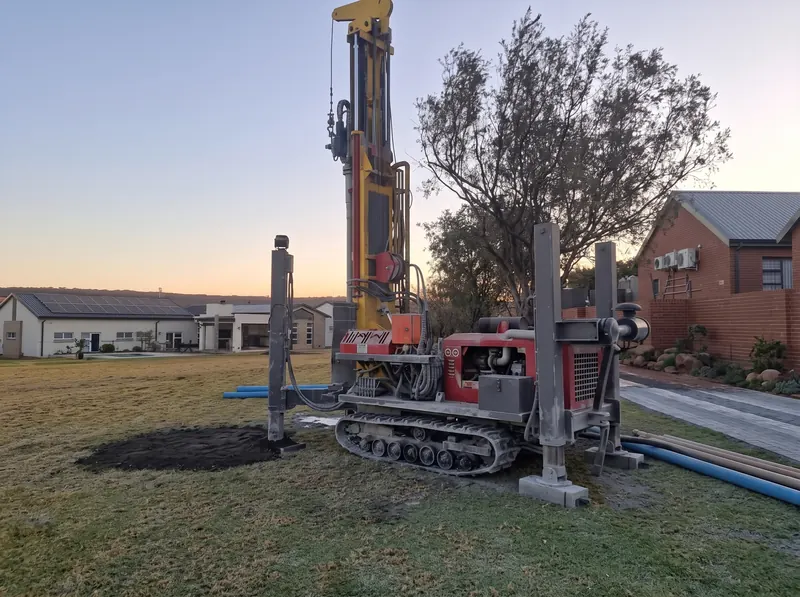
Our tracked rig moves into position. In hard rock, as in Pinetown and the Upper Highway, it drills with a down-the-hole (DTH) pneumatic air percussion hammer. In loose, sandy coastal ground, where compressed air would blow the walls out, we drill by mud rotary instead, with drilling fluid holding the hole open.
- 03
Case the hole
Casing stops the borehole collapsing and keeps surface water out. Heavy-gauge steel casing is driven through the loose top layers into solid bedrock, sealing off contaminated runoff. Where the ground calls for it, slotted and plain uPVC casing runs the full depth, with a gravel pack around it to keep fine sand out of the pump.
- 04
Strike water and cap
We drill on until the main water-bearing fissure is struck and the flow is confirmed, then cap the borehole with a sanitary seal so nothing washes in from the surface. A yield test tells you how much water it can safely give.
03
Drilling matched to the ground
Ground around Durban changes from hard rock inland to loose sand along the coast. We drill and case each borehole for the ground it’s in.
Air percussion (DTH)
A high-pressure air hammer that breaks through hard sandstone, tillite and granite. Our main method in Pinetown, Westville, Kloof and Hillcrest, and the one behind a client’s 100m borehole drilled in six hours.
Mud rotary
For sand, clay and alluvium, as along the coast in Durban North, uMhlanga and Ballito. Drilling fluid supports the walls so the hole doesn’t cave in before it’s cased.
Steel casing
Thick-wall steel driven through the unstable top layers into bedrock. It keeps the top of the borehole open and seals out contaminated surface water.
uPVC casing and gravel pack
Slotted and plain uPVC casing down the shaft, with a gravel pack around it, lets water in while keeping out the fine sand that wears pumps out.
04
Why our drilling holds up
Built for hard rock
Our rigs have 100m+ deep rock capacity. One client’s 100m borehole was drilled in six hours.
Casing that suits the ground
Steel through unstable ground, so the borehole stays open and the water stays clean for years.
One team, start to finish
The same crew surveys, drills, cases and equips your borehole. No subcontractors passing the job along.
Based in Pinetown
Our rig and support bakkies work out of 29 Caversham Rd, Pinetown, close to most of Greater Durban.
05
After the drilling
A borehole on its own is a hole with water at the bottom. To use it you need a pump, and usually storage. We install solar and electric submersible pumps, JoJo tanks with booster pumps, and filtration if your water test calls for it, so you deal with one team for the whole system.
Want to know what drives the price? Read what a borehole costs.
Areas
Where we drill
From our yard in Pinetown we drill across Greater Durban, the Highway Area, the North Coast and developments throughout KwaZulu-Natal.
“Kelvin and his crew drilled us a 100m deep borehole in 6 hours. We are grateful for excellent work. I can recommend them any time.”
Questions, answered
Common questions
How long does it take to drill a borehole?
The drilling itself is usually done in a day, depending on depth and how hard the rock is: one client’s 100m borehole was drilled in six hours. Equipping it with a pump and tank adds time, and Kelvin will give you a timeline at the site survey.
How deep will my borehole be?
It depends on where the water-bearing rock is on your property, which the site survey helps predict. Many boreholes around Durban need to go deep into the rock, which is why our rigs are built for 100m+.
Why does a borehole need casing?
The top of a borehole runs through soil and weathered rock that can collapse or wash in. Casing lines that section so the hole stays open and the water stays clean. We use steel casing through unstable ground into bedrock, and uPVC casing with a gravel pack where sand needs keeping out.
What’s the difference between air percussion and mud rotary drilling?
Air percussion uses a high-pressure air hammer and is fastest through hard rock, so it’s our main method inland. Mud rotary uses drilling fluid to hold up loose walls, so it’s used in sandy or clay ground such as along the coast. Some boreholes use both: mud rotary through the sand, then air percussion into the rock below.
Can you get a rig onto my property?
Our tracked rig copes with sloping and tight sites better than a truck-mounted rig, but it still needs a path in. Kelvin checks access during the site survey and agrees the drilling spot with you.
Which areas do you drill in?
Pinetown, Westville, Kloof, Hillcrest and the Highway Area, Durban North, uMhlanga, Ballito and developments across KwaZulu-Natal. See the area pages below for each one.
Keep reading
Related
Talk to Kelvin directly