
Service · Existing boreholesBorehole repairs & yield testing.
An existing borehole that’s slowed down, run dry or started pumping mud isn’t always finished. We diagnose the problem, then deepen, clean, re-equip or cap it, and yield test it so you know what it can give.
★ 4.6 from 25 Google reviews · Est. 2010 · Pinetown, Durban
01
Common borehole problems
The pump runs but little or no water comes out. The water has turned cloudy or sandy. The borehole gives less than it used to, or dries up in winter. The pump keeps tripping. Each has a different cause, from a failed pump to a silted-up hole or a water table that has dropped below the bottom of the borehole.
02
What we do
Deepening
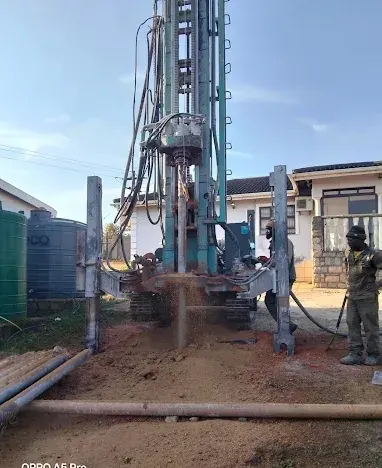
If a borehole has dried out or gives too little, drilling it deeper can reach a stronger water-bearing zone below.
Hydro-fracturing
For a low-yield borehole in rock, water pumped in at high pressure opens and cleans the fractures around the hole so more water can flow in.
Flushing and cleaning
Air-flushing and jetting at 21 to 25 bar blow out the silt, sand and debris that clog a borehole and choke its flow.
Pump retrieval and replacement
Stuck or burnt-out pumps are pulled out safely and replaced with a solar or electric submersible pump matched to the borehole.
Rising main and cable
Corroded or damaged HDPE rising main, safety rope and submersible cable replaced, a common cause of leaks, low pressure and lost pumps.
Control box faults
Faulty pressure control and pump control boxes diagnosed and fixed, so the pump starts and stops when it should.
Yield testing
Stepped and constant-rate yield tests, with recovery testing, show in litres per hour how much water the borehole can safely give, so the pump never over-draws it.
Sanitary capping
A sealed wellhead stops surface water, insects and debris from getting into the borehole and contaminating it.
03
What a yield test tells you
A yield test pumps the borehole at a steady rate while the water level is measured, then times how fast the level recovers once pumping stops. The result is the rate the borehole can sustain: the number that decides what size pump to fit and how much water you can rely on each day.
It’s worth doing on any new borehole, any borehole you’re buying with a property, and any borehole that’s started to struggle. To stop small problems becoming big ones, see our borehole maintenance guide.
“I’m very happy with the team. They were very professional and they work within the time they promised to deliver their service. Borehole is running smoothly.”
Questions, answered
Common questions
Can a dry borehole be fixed?
Often, yes. If the water table has dropped, deepening the borehole can reach water further down. If it’s clogged with sediment, cleaning can restore the flow. Kelvin will look at it and tell you which is worth doing.
Why is my borehole pumping sand or mud?
It can mean the casing is damaged or too short, the borehole is silting up, or the pump is drawing harder than the borehole can supply. Cleaning, re-casing or a correctly sized pump usually solves it.
How is borehole yield measured?
With a yield test: the borehole is pumped at a steady rate while the water level is measured, and then the recovery is timed. The result is given in litres per hour.
Can you get a stuck pump out of a borehole?
Usually, yes. We retrieve stuck and burnt-out pumps, and replace corroded rising main, rope and cable while the borehole is open, which is often why the pump got stuck or failed in the first place.
Do you repair boreholes another company drilled?
Yes. We work on existing boreholes whoever drilled them.
Keep reading
Related
Talk to Kelvin directly